
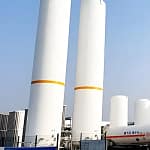
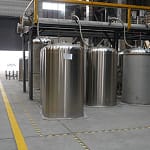

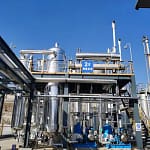


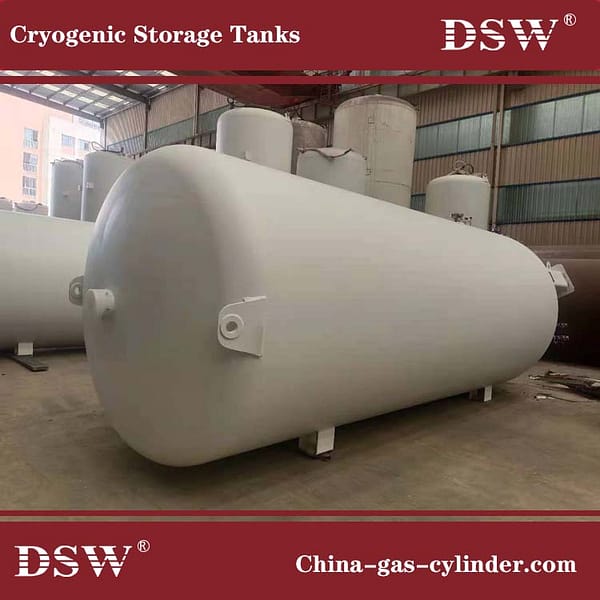

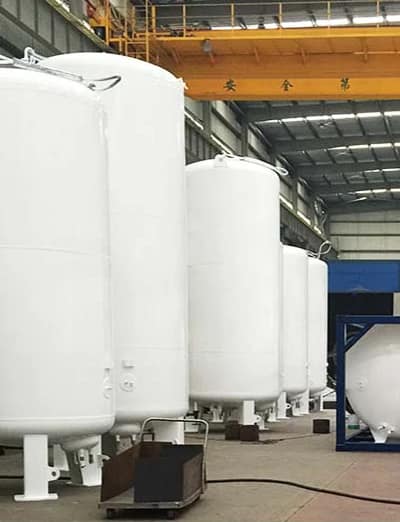
Cryogenic storage tanks are specialized vessels used to store liquefied gases such as nitrogen, oxygen, argon, and LNG at extremely low temperatures. These tanks are commonly used for storing liquid nitrogen (LIN), liquid oxygen (LOX), liquid argon (LAR), LNG, liquid carbon dioxide (CO₂), and other cryogenic fluids.
Unlike ordinary storage tanks, cryogenic storage tanks use vacuum insulation technology, double-wall construction, and pressure control systems to maintain extremely cold temperatures and reduce evaporation losses.
Cryogenic storage tanks play an important role in industries that require a reliable supply of industrial gases, including healthcare, electronics manufacturing, chemical processing, metal fabrication, energy, and scientific research.
DSW Industry designs and manufactures customized vacuum insulated cryogenic storage tanks for industrial gas applications, providing safe and efficient storage solutions according to international pressure vessel standards.
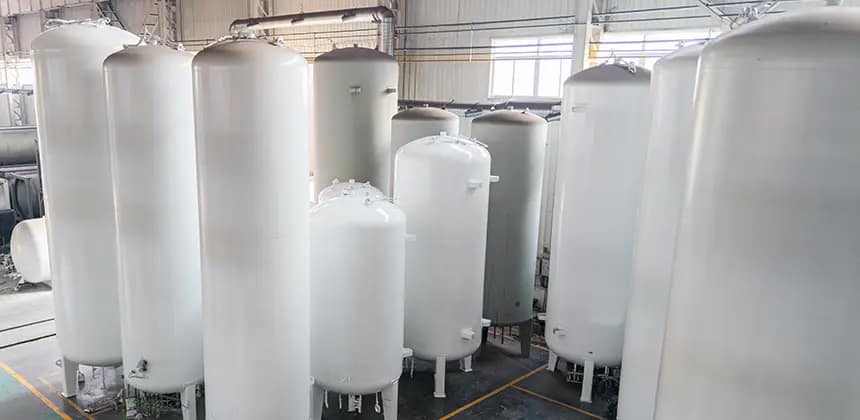
What Does Cryogenic Mean?
The word cryogenic refers to technologies involving extremely low temperatures, generally below approximately -150°C.
At these temperatures, many gases can be converted from their normal gaseous state into liquid form. Storing gases as liquids significantly reduces their volume, making transportation and storage more efficient.
| Gas | Liquid Boiling Temperature | Common Use |
|---|---|---|
| Liquid Nitrogen (LIN) | -196°C | Electronics, food freezing, laboratories |
| Liquid Oxygen (LOX) | -183°C | Medical oxygen and industrial processes |
| Liquid Argon (LAR) | -186°C | Welding and metal processing |
| LNG | -162°C | Energy and fuel applications |
| Liquid CO₂ | -78.5°C | Food, beverage, chemical industries |
Why Are Cryogenic Storage Tanks Needed?
Many industrial gases are required in large quantities. Storing these gases in compressed cylinders is often inefficient because cylinders have limited capacity and require frequent replacement.
Cryogenic storage tanks solve this problem by storing gases in liquid form, allowing a much larger amount of gas to be stored in a smaller space.
Main Advantages of Cryogenic Storage Tanks
- Large Storage Capacity: Store much higher volumes compared with compressed gas cylinders.
- Continuous Gas Supply: Provide stable gas supply for industrial operations.
- Lower Operating Cost: Reduce cylinder handling and replacement requirements.
- Improved Efficiency: Support automated gas delivery systems.
- Better Space Utilization: Store large quantities of gas in liquid form.
1. Double-Wall Construction
A cryogenic storage tank consists of an inner vessel and an outer vessel.
| Tank Section | Function |
|---|---|
| Inner Vessel | Stores the cryogenic liquid and withstands internal pressure |
| Outer Vessel | Provides structural protection and creates vacuum space |
The space between the two vessels is evacuated to create a vacuum insulation layer, which minimizes heat transfer from the outside environment.
2. Vacuum Insulation System
Vacuum insulation is the key technology that allows cryogenic liquids to remain stable for long periods.
The vacuum layer reduces:
- Heat conduction
- Heat convection
- Radiation heat transfer
- Liquid evaporation
Many high-performance cryogenic tanks also use multi-layer insulation (MLI) materials to further improve thermal performance.
3. Pressure Control System
Although insulation reduces heat transfer, a small amount of heat will always enter the tank. This causes some liquid to evaporate and create gas pressure.
Cryogenic tanks control this pressure using:
- Pressure-building coils
- Economizer systems
- Pressure regulators
- Safety relief valves
Main Components of a Cryogenic Storage Tank
A cryogenic storage tank is a complete engineered system consisting of several components that work together to maintain extremely low temperatures, control pressure, and provide a reliable supply of cryogenic liquid or gas.
1. Inner Pressure Vessel
The inner vessel is the primary container that directly contacts the cryogenic liquid. It must maintain mechanical strength at extremely low temperatures and withstand internal pressure during operation.
Common materials include:
- 304 stainless steel
- 304L stainless steel
- 316L stainless steel
The inner vessel design focuses on:
- Low-temperature toughness
- Pressure resistance
- Corrosion resistance
- Long service life
2. Outer Vessel
The outer vessel surrounds the inner tank and provides structural protection. It also forms the vacuum jacket required for thermal insulation.
The outer vessel helps:
- Maintain vacuum conditions
- Protect internal components
- Support mechanical strength
- Reduce external heat transfer
3. Vacuum Jacket
The vacuum jacket is the space between the inner and outer vessels where air is removed to create a vacuum environment.
By reducing the presence of air molecules, the vacuum layer minimizes heat transfer and improves insulation performance.
4. Multi-Layer Insulation (MLI)
Many modern cryogenic storage tanks use multi-layer insulation materials inside the vacuum jacket.
MLI reduces radiation heat transfer by using multiple reflective insulation layers, helping lower boil-off rates and improve storage efficiency.
5. Cryogenic Valves and Piping System
Cryogenic tanks include specially designed valves and pipelines that can operate safely at extremely low temperatures.
| Component | Function |
|---|---|
| Liquid Filling Line | Transfers cryogenic liquid into the tank |
| Liquid Outlet Line | Supplies liquid cryogenic products |
| Gas Outlet Line | Provides vaporized gas supply |
| Vent Line | Controls excessive pressure |
| Safety Valve | Protects against overpressure |
6. Monitoring and Safety Devices
Cryogenic storage tanks are equipped with monitoring devices to ensure safe operation.
- Pressure gauges
- Liquid level indicators
- Temperature sensors
- Safety relief valves
- Control valves
Types of Cryogenic Storage Tanks
Cryogenic storage tanks are available in different designs depending on storage capacity, operating pressure, and application requirements. The following table compares the most common types of cryogenic storage tanks used in industrial, medical, laboratory, and energy applications.
| Tank Type | Typical Capacity | Main Application |
|---|---|---|
| Dewar Flask | 1–200 L | Laboratories, medical facilities, biological samples, and scientific research. |
| Cryogenic Liquid Cylinder (DPL Cylinder) | 80–500 L | Portable liquid gas supply for hospitals, laboratories, welding, and industrial users. |
| MicroBulk Storage Tank | 450–7,500 L | Medium-volume gas supply for manufacturing, food processing, healthcare, and laboratories. |
| Self-Pressurized Cryogenic Tank | 500–5,000 L | Dispensing liquid nitrogen, oxygen, or argon without an external vaporizer. |
| Vertical Cryogenic Storage Tank | 3–100 m³ | Industrial gas plants, hospitals, manufacturing facilities, and air separation units. |
| Horizontal Cryogenic Storage Tank | 3–100 m³ | Large-capacity stationary storage where installation height is limited. |
| LNG Storage Tank | 10–200,000 m³ | LNG terminals, fueling stations, power plants, and energy infrastructure. |
| Liquid Hydrogen Storage Tank | 1–100 m³+ | Hydrogen energy, aerospace, semiconductor manufacturing, and research facilities. |
| Cryogenic ISO Tank Container | 10–24 m³ | International intermodal transportation of liquid nitrogen, oxygen, argon, LNG, and other cryogenic liquids. |
| Cryogenic Tank Trailer | 10–60 m³ | Bulk road transportation of cryogenic liquids between production plants and end users. |
The following sections explain how each type of cryogenic storage tank works, its advantages, and the industries where it is most commonly used.
1. Dewar Flask
A Dewar flask is the smallest type of cryogenic storage container, designed for storing liquid nitrogen, liquid oxygen, and other cryogenic liquids in laboratories and research facilities. Its double-wall vacuum insulation minimizes heat transfer, making it ideal for small-volume storage, biological samples, and scientific experiments.
Typical applications: Laboratories, hospitals, universities, biotechnology, and scientific research.
2. Cryogenic Liquid Cylinder (DPL Cylinder)
A cryogenic liquid cylinder, also called a DPL cylinder, is a portable vacuum-insulated pressure vessel that stores liquefied gases such as nitrogen, oxygen, argon, and carbon dioxide. It offers greater gas capacity than conventional cylinders and provides a continuous gas supply for medium-volume users.
Typical applications: Hospitals, welding, laboratories, food processing, and industrial gas supply.
3. MicroBulk Storage Tank
A MicroBulk storage tank bridges the gap between portable cryogenic cylinders and large bulk storage tanks. It provides a reliable gas supply with fewer deliveries and less cylinder handling, making it an efficient solution for facilities with moderate gas consumption.
Typical applications: Manufacturing, food processing, healthcare, laboratories, and laser cutting.
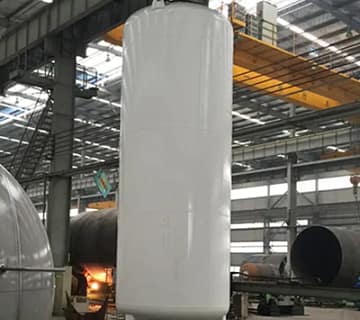
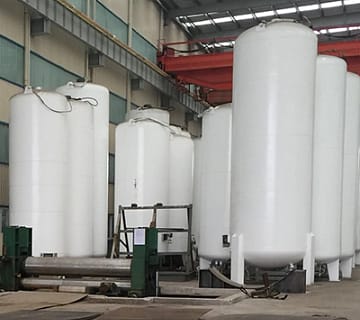
4. Vertical Cryogenic Storage Tank
A vertical cryogenic storage tank is the most common stationary storage solution for liquid nitrogen, oxygen, argon, and other cryogenic gases. Its upright design saves installation space while providing excellent insulation and long-term storage performance.
Typical applications: Hospitals, industrial gas plants, air separation units, and manufacturing facilities.
5. Horizontal Cryogenic Storage Tank
A horizontal cryogenic storage tank offers the same vacuum-insulated performance as a vertical tank but is installed on support saddles. It is often selected where installation height is limited or where easier transportation and maintenance are required.
Typical applications: Industrial gas plants, chemical facilities, LNG projects, and manufacturing sites.
6. LNG Storage Tank
An LNG storage tank is specifically designed to store liquefied natural gas at approximately -162°C. Depending on the application, LNG tanks may be vacuum-insulated pressure vessels or large flat-bottom storage tanks for energy infrastructure.
Typical applications: LNG terminals, fueling stations, power plants, and industrial energy systems.
7. Liquid Hydrogen Storage Tank
A liquid hydrogen storage tank stores hydrogen at approximately -253°C. These tanks require advanced insulation systems and specialized materials to safely maintain one of the lowest storage temperatures used in industry.
Typical applications: Hydrogen energy, aerospace, semiconductor manufacturing, and scientific research.
8. Cryogenic ISO Tank Container
A cryogenic ISO tank container is a portable tank built to ISO container dimensions for transporting liquefied gases by road, rail, and sea. Unlike stationary storage tanks, it is designed for safe multimodal transportation.
Typical applications: International logistics, industrial gas distribution, and bulk cryogenic liquid transportation.
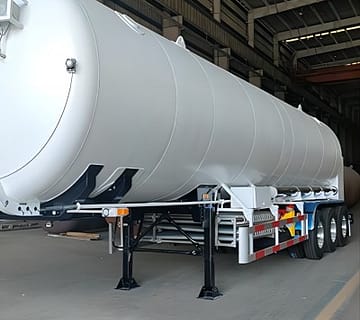
9. Cryogenic Tank Trailer
A cryogenic tank trailer is a road tanker used to transport bulk quantities of liquid oxygen, nitrogen, argon, LNG, and other cryogenic products between production plants and customer facilities. It plays an essential role in industrial gas distribution.
Typical applications: Bulk gas delivery, industrial gas suppliers, hospitals, and manufacturing plants.
Cryogenic Storage Tank vs Gas Cylinder
Cryogenic storage tanks and compressed gas cylinders are both used for gas supply, but they serve different purposes.
| Feature | Cryogenic Storage Tank | Gas Cylinder |
|---|---|---|
| Storage Form | Liquefied gas | Compressed gas |
| Storage Capacity | Large volume | Limited volume |
| Gas Supply | Continuous supply | Requires replacement |
| Best For | Industrial users with high consumption | Small users or temporary applications |
| Operating Cost | Lower for large consumption | Higher for frequent replacement |
For industries requiring a stable and continuous gas supply, cryogenic storage tanks are usually more efficient than traditional cylinder systems.
Applications of Cryogenic Storage Tanks
Cryogenic storage tanks are used across many industries where large quantities of liquefied gases are required.
Medical and Healthcare Applications
Hospitals and healthcare facilities use cryogenic storage tanks mainly for medical oxygen supply.
Applications include:
- Hospital oxygen systems
- Medical gas pipelines
- Emergency oxygen supply
Industrial Gas Applications
Industrial gas suppliers use cryogenic storage tanks to store and distribute:
- Liquid nitrogen
- Liquid oxygen
- Liquid argon
- Carbon dioxide
Industries using these gases include:
- Metal fabrication
- Welding
- Steel production
- Manufacturing
Electronics and Semiconductor Industry
High-purity nitrogen is essential in electronics manufacturing because it provides an inert atmosphere that prevents oxidation and contamination.
Cryogenic nitrogen storage tanks support:
- Semiconductor production
- PCB manufacturing
- Precision electronics assembly
- Cleanroom processes
Food Processing Industry
Cryogenic gases are widely used in food processing because they provide rapid cooling and freezing.
Applications include:
- Food freezing
- Packaging
- Beverage processing
- Cold chain applications
Chemical and Energy Industries
Chemical plants and energy companies use cryogenic storage systems for reliable gas supply during production and processing operations.
Typical applications include:
- Process gas supply
- Inert gas protection
- LNG storage
- Hydrogen and advanced energy research
Research and Aerospace
Scientific institutions and aerospace companies use cryogenic storage tanks for applications requiring extremely low temperatures.
Examples include:
- Laboratory experiments
- Rocket testing
- Superconducting research
- Advanced materials research
What Is a Cryogenic Storage System?
A cryogenic storage system is more than just a storage tank. It is a complete gas supply solution that includes the cryogenic storage vessel, piping system, valves, pressure control equipment, and vaporization equipment.
The purpose of cryogenic storage systems is to safely store liquefied gases and provide a stable supply of gas for industrial applications.
Typical Components of a Cryogenic Storage System
| Equipment | Function |
|---|---|
| Cryogenic Storage Tank | Stores liquefied gases at extremely low temperatures |
| Cryogenic Vaporizer | Converts liquid gas into gaseous form |
| Piping System | Transfers liquid and gas between equipment |
| Pressure Control Unit | Maintains stable operating pressure |
| Safety Equipment | Protects the system from abnormal conditions |
For many industrial users, a complete cryogenic storage system provides better reliability and efficiency than using individual gas cylinders.
How to Choose the Right Cryogenic Storage Tank?
Choosing a suitable cryogenic storage tank requires evaluating the application requirements, gas consumption, installation environment, and regulatory requirements.
1. Identify the Cryogenic Medium
The stored gas determines the material selection, insulation requirements, and safety design.
Common cryogenic media include:
- Liquid Nitrogen (LIN)
- Liquid Oxygen (LOX)
- Liquid Argon (LAR)
- LNG
- Liquid CO₂
For example, liquid oxygen storage requires strict cleanliness control and oxygen-compatible components due to its oxidizing properties.
2. Determine Required Storage Capacity
The correct tank capacity depends on:
- Daily gas consumption
- Peak demand
- Refilling frequency
- Required backup storage
- Future expansion plans
Large industrial plants normally require bulk cryogenic tanks, while laboratories and smaller facilities may use MicroBulk systems.
3. Consider Operating Pressure
Cryogenic storage tanks are manufactured according to different pressure requirements.
The design pressure affects:
- Tank structure
- Valve selection
- Piping design
- Safety system configuration
4. Evaluate Installation Conditions
The installation environment should be considered before selecting a tank design.
- Available installation space
- Indoor or outdoor installation
- Foundation requirements
- Transportation access
- Local climate conditions
Cryogenic Storage Tank Standards and Certifications
Because cryogenic storage tanks are pressure vessels operating under extreme temperatures, they must comply with strict safety and manufacturing standards.
| Standard | Description |
|---|---|
| ASME Section VIII | Pressure vessel design and manufacturing requirements |
| PED 2014/68/EU | European pressure equipment requirements |
| EN 13458 | European standard for cryogenic vessels |
| ISO Standards | International cryogenic equipment requirements |
| GB Standards | Chinese pressure vessel regulations |
Compliance with these standards helps ensure tank safety, reliability, and suitability for international industrial applications.
Understanding Cryogenic Storage Tanks
A cryogenic storage tank is a critical piece of equipment for industries requiring efficient storage and supply of liquefied gases. Through vacuum insulation technology, double-wall construction, and advanced pressure control systems, these tanks maintain cryogenic liquids safely and efficiently.
From hospitals and electronics manufacturers to industrial gas companies and energy projects, cryogenic storage tanks provide a reliable alternative to traditional compressed gas cylinder systems.
Understanding how cryogenic storage tanks work, their different types, and their applications helps businesses select the right solution for their gas supply requirements.
DSW Industry provides customized cryogenic storage tank solutions for industrial gas, medical, manufacturing, energy, and research applications.
TECHNICAL QUESTIONS
FAQs About what is a cryogenic storage tank
A cryogenic storage tank is a specially designed insulated pressure vessel used to store liquefied gases at extremely low temperatures. Common cryogenic fluids stored in these tanks include liquid nitrogen, liquid oxygen, liquid argon, LNG, and liquid carbon dioxide.
A cryogenic storage tank works by using double-wall construction, vacuum insulation, and pressure control systems to keep liquefied gases at very low temperatures. The vacuum layer reduces heat transfer from the environment and minimizes evaporation losses.
Cryogenic storage tanks are insulated to prevent heat from entering the tank. Effective vacuum insulation and multi-layer insulation reduce heat transfer, maintain low temperatures, and help minimize boil-off of stored cryogenic liquids.
Cryogenic storage tanks are commonly used for storing liquid nitrogen (LIN), liquid oxygen (LOX), liquid argon (LAR), LNG, and liquid carbon dioxide (CO2). The suitable tank design depends on the properties of each cryogenic fluid.
The main components of a cryogenic storage tank include the inner vessel, outer vessel, vacuum jacket, insulation system, cryogenic valves, piping system, pressure gauges, and safety relief devices.
A cryogenic storage tank stores gases in liquid form at extremely low temperatures and is designed for large-volume continuous supply. Gas cylinders store compressed gases and are generally used for smaller quantities or portable applications.
Cryogenic storage tanks are used in many industries including healthcare, industrial gas supply, electronics manufacturing, food processing, chemical production, energy, aerospace, and scientific research.
Yes. Cryogenic storage tanks are designed with safety systems such as pressure relief valves, monitoring instruments, and controlled venting systems. When manufactured according to pressure vessel standards and operated correctly, they provide safe and reliable storage.



No comment