





Cryogenic pumps are available in several designs to handle different flow rates, pressures, installation arrangements, and liquefied gases. The most suitable type depends on the application, including bulk liquid transfer, gas cylinder filling, LNG fueling, air separation, or cryogenic gas supply.
Common cryogenic pump designs include centrifugal pumps, reciprocating pumps, submerged pumps, and specialized cryogenic transfer pumps. Pump skids can also integrate the pump with valves, piping, instrumentation, and controls to provide a packaged system.
This guide explains the main types of cryogenic pumps, how they differ, and where each design may be appropriate.
How Are Cryogenic Pumps Classified?
Cryogenic pumps can be classified in several ways:
- By pumping mechanism
- By installation configuration
- By flow and pressure requirements
- By the cryogenic liquid being handled
- By the application
The same pump may fit into more than one category. For example, a pump can be both a centrifugal pump and a submerged cryogenic pump.
Types of Cryogenic Pumps
Cryogenic pumps can be classified according to their pumping mechanism, installation method, and application.
| Pump Type | Main Principle / Configuration | Typical Applications |
|---|---|---|
| Centrifugal Cryogenic Pumps | Rotating impeller designed for efficient, high-flow liquid transfer | Bulk liquid transfer, air separation plants, LNG systems, and industrial gas supply |
| Reciprocating Cryogenic Pumps | Piston or plunger mechanism for controlled, high-pressure liquid delivery | High-pressure gas supply, cylinder filling, LNG systems, and specialized transfer |
| Submerged Cryogenic Pumps | Pump installed inside or closely integrated with the storage vessel | LNG and cryogenic liquid transfer where compact integration is important |
| Cryogenic Transfer Pumps | Designed specifically to transfer liquefied gases between cryogenic equipment | Tank transfer, filling stations, vaporizers, transport equipment, and gas supply systems |
| Cryogenic Pump Skids | Integrated pump, valves, piping, instrumentation, and controls on a common skid | LNG transfer, industrial gas supply, and integrated process systems |
1. Centrifugal Cryogenic Pumps
Centrifugal cryogenic pumps use a rotating impeller to transfer energy to the liquid. They are generally suitable for applications requiring relatively high liquid flow rates.
The rotating impeller creates the pressure and flow needed to move the cryogenic liquid through the system.
Advantages
- Suitable for relatively high flow rates
- Continuous liquid transfer
- Commonly available in different configurations
- Suitable for many bulk transfer applications
Typical Applications
- Bulk cryogenic liquid transfer
- Air separation plants
- Industrial gas facilities
- LNG transfer systems
- Storage tank transfer
2. Reciprocating Cryogenic Pumps
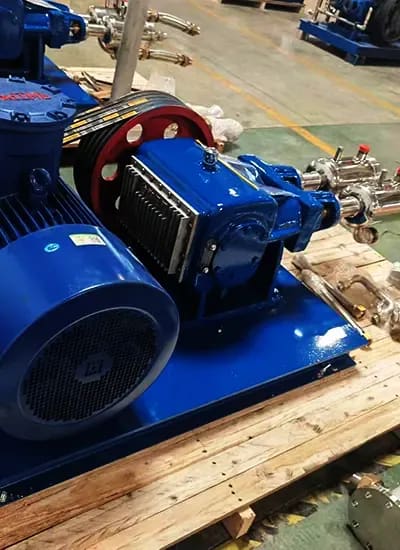
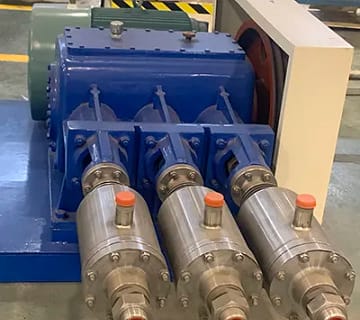
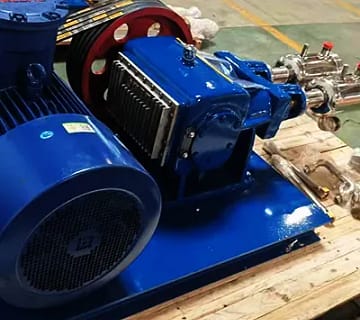
Reciprocating cryogenic pumps use pistons or plungers to move liquid through the pump. The reciprocating motion provides controlled displacement and can generate relatively high discharge pressures.
These pumps can be particularly suitable when the application requires high pressure rather than simply high flow.
Typical Applications
- High-pressure gas supply
- Cylinder filling
- High-pressure LNG systems
- Specialized cryogenic transfer
When selecting a reciprocating pump, engineers should consider the required flow, pressure, operating frequency, pulsation, maintenance requirements, and downstream system design.
3. Submerged Cryogenic Pumps
Submerged cryogenic pumps are installed inside or closely integrated with a cryogenic storage vessel so that the pump remains immersed in the liquid.
This configuration can help maintain favorable suction conditions because the pump is located close to the liquid source.
Submerged pumps may be used when compact installation, reliable liquid supply, and suitable suction conditions are important.
Potential Benefits
- Short suction path
- Favorable inlet conditions
- Compact system arrangement
- Reduced exposure of certain components to ambient conditions
4. Cryogenic Transfer Pumps
The term cryogenic transfer pump describes pumps designed specifically to transfer liquefied gases between cryogenic equipment.
They may be used to move liquid:
- From storage tanks to filling systems
- From transport tanks to stationary storage
- From storage tanks to vaporizers
- Between storage vessels
- From LNG storage to fueling equipment
A cryogenic transfer pump may use centrifugal, reciprocating, or another pumping mechanism depending on the application.
5. Cryogenic Pump Skids
A cryogenic pump skid is a packaged assembly that combines a pump with associated piping, valves, instrumentation, controls, and supporting equipment.
Instead of supplying a pump as an isolated component, a skid can provide a more complete transfer or pressure-boosting package.
Typical skid components may include:
- Cryogenic pump
- Inlet and outlet piping
- Isolation valves
- Check valves
- Pressure instrumentation
- Flow instrumentation
- Control system
- Safety devices
- Structural skid frame
For LNG applications, for example, a pump skid can be designed to transfer LNG from storage to a vaporizer or high-pressure supply system.
Centrifugal vs. Reciprocating Cryogenic Pumps
| Feature | Centrifugal | Reciprocating |
|---|---|---|
| Operating principle | Rotating impeller | Piston or plunger |
| Typical strength | Higher flow | Higher pressure |
| Flow characteristics | Generally continuous | Positive displacement |
| Typical applications | Bulk transfer | High-pressure transfer and filling |
| System considerations | Head, flow and NPSH | Pressure, pulsation and displacement |
Neither type is universally better. The correct choice depends on the required flow, pressure, fluid, operating cycle, installation, and system configuration.
Positive-Displacement Cryogenic Pumps
Reciprocating pumps are a common form of positive-displacement pump. Instead of relying primarily on velocity generated by an impeller, a positive-displacement pump moves a defined volume of liquid during each operating cycle.
This can make the design suitable for applications requiring high pressure or controlled liquid delivery.
However, the system must be designed appropriately for pressure relief and pulsation control because positive-displacement pumps can continue generating pressure when downstream flow is restricted.
How to Select the Right Type of Cryogenic Pump
Choosing the right pump starts with defining the complete operating conditions.
Flow Rate
Determine the normal and required maximum flow rate. Bulk transfer applications may prioritize high flow, while filling applications may require controlled flow.
Discharge Pressure
Calculate the pressure required at the pump outlet, including downstream equipment pressure and piping losses.
Suction Conditions
Evaluate available suction pressure and NPSH conditions. Cryogenic liquids can vaporize when pressure drops sufficiently, making suction design particularly important.
Liquid Type
Different liquids have different temperatures, densities, vapor pressures, material compatibility requirements, and safety considerations.
Installation Configuration
Consider whether the pump will be installed horizontally, vertically, submerged, or as part of a packaged skid.
Operating Cycle
Continuous industrial operation may require a different pump configuration from intermittent cylinder filling or vehicle fueling.
Common Cryogenic Pump Materials
Cryogenic pump materials must maintain suitable mechanical properties and compatibility at low temperatures.
Materials may include stainless steels and other materials selected according to the specific cryogenic fluid, temperature, pressure, and service conditions.
Material selection should also consider thermal contraction, corrosion resistance, cleanliness, and compatibility with the pumped medium.
Special Considerations for Oxygen Service
Liquid oxygen requires special attention because oxygen is a strong oxidizer.
Equipment used for LOX service may require specific material selection, cleaning procedures, compatible lubricants and seals, and oxygen-service preparation.
A pump designed for general cryogenic service should not automatically be assumed to be suitable for oxygen service without confirming the applicable requirements.
Common Problems with Cryogenic Pumps
Cavitation
Cavitation can occur when local liquid pressure falls sufficiently for vapor bubbles to form. It can result in vibration, noise, reduced performance, and potential pump damage.
Vapor Lock
Excessive vapor entering the pump can interrupt stable liquid flow. Correct suction design, cooldown procedures, tank pressure, and operating conditions help reduce this risk.
Thermal Shock
Rapid temperature changes can cause thermal stress and component contraction. Proper cooldown procedures are therefore important.
Seal Problems
Seals must maintain suitable performance at cryogenic temperatures and under the expected pressure conditions.
Cryogenic Pump Selection Checklist
Before selecting a pump, define:
- Gas or liquid type
- Operating temperature
- Normal flow rate
- Maximum flow rate
- Required discharge pressure
- Available suction pressure
- NPSH conditions
- Tank size and configuration
- Pipe length and elevation
- Operating cycle
- Installation arrangement
- Material requirements
- Oxygen-service requirements if applicable
- Control requirements
- Applicable codes and regulations
TECHNICAL FAQs
FAQs About Types of Cryogenic Pumps
The main types include centrifugal cryogenic pumps, reciprocating or positive-displacement pumps, submerged pumps, and specialized cryogenic transfer pumps. Pump skids can integrate these pumps with other system components.
Centrifugal pumps are often considered for applications requiring relatively high continuous flow, although the final selection depends on the cryogenic fluid and system requirements.
Reciprocating or other positive-displacement pump designs may be suitable for high-pressure applications, depending on the required flow, pressure, cryogenic fluid, and system configuration.
A submerged cryogenic pump is installed inside or closely integrated with a cryogenic storage vessel and operates while immersed in the cryogenic liquid. This configuration can provide favorable suction conditions and a compact system arrangement.
A cryogenic pump skid is a packaged system combining a cryogenic pump with piping, valves, instrumentation, controls, and supporting equipment. It can provide an integrated solution for applications such as cryogenic liquid transfer and LNG systems.
Conclusion
Different cryogenic pump designs serve different applications. Centrifugal pumps are commonly associated with higher-flow transfer, while reciprocating pumps can be suitable for higher-pressure applications. Submerged configurations can provide favorable suction conditions, while pump skids integrate pumping equipment into a more complete package.
The best pump should be selected based on the cryogenic fluid, temperature, flow rate, pressure, suction conditions, installation configuration, and overall system requirements.



No comment