
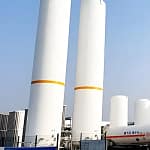
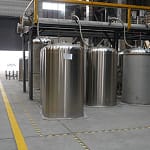

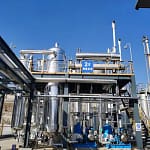


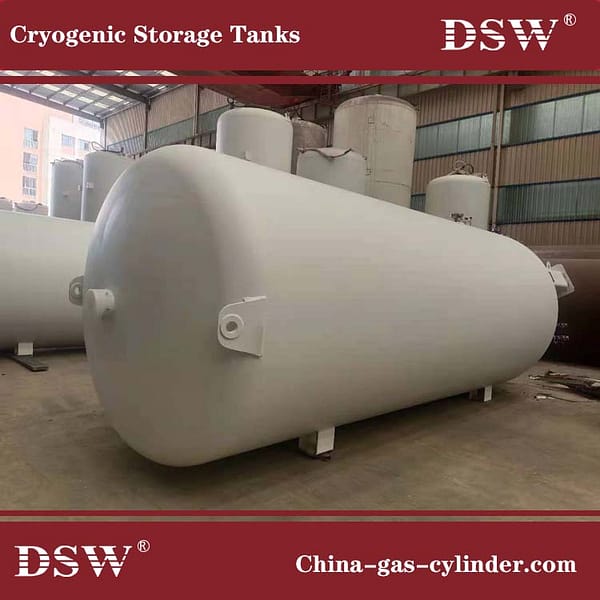

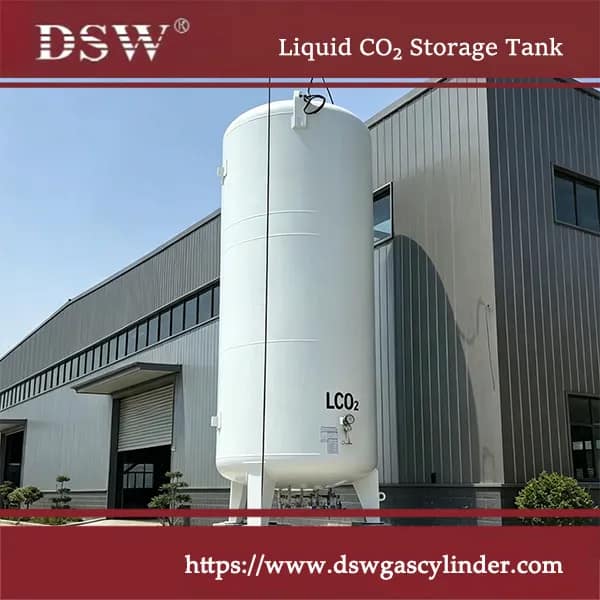
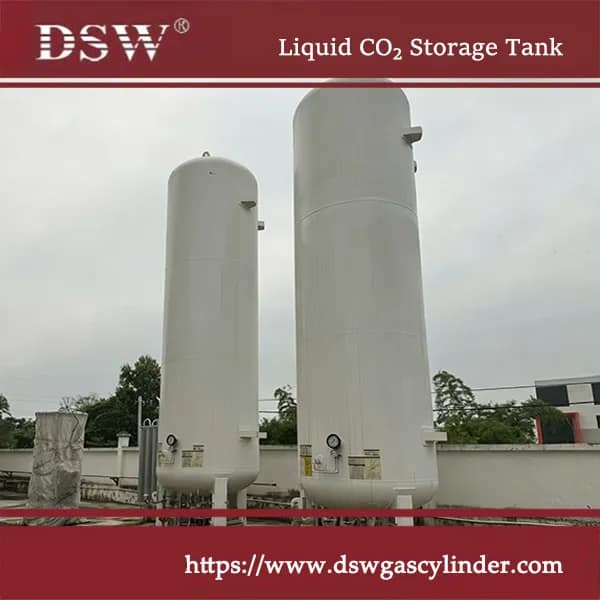

DSW supplies vacuum-insulated liquid CO₂ storage tanks for the bulk storage and reliable supply of liquid carbon dioxide (LCO₂). Our stationary cryogenic tanks are designed for industrial applications requiring stable storage pressure, low product loss, and a continuous downstream CO₂ supply. Available in capacities from 5 m³ to 100 m³, our liquid CO₂ tanks can be selected according to gas consumption, available installation space, and operational requirements. Typical applications include beverage production, food processing, dry ice manufacturing, chemical processing, welding, and other industrial CO₂ supply systems. For a broader range of storage solutions, explore our LCO₂ cryogenic tanks.
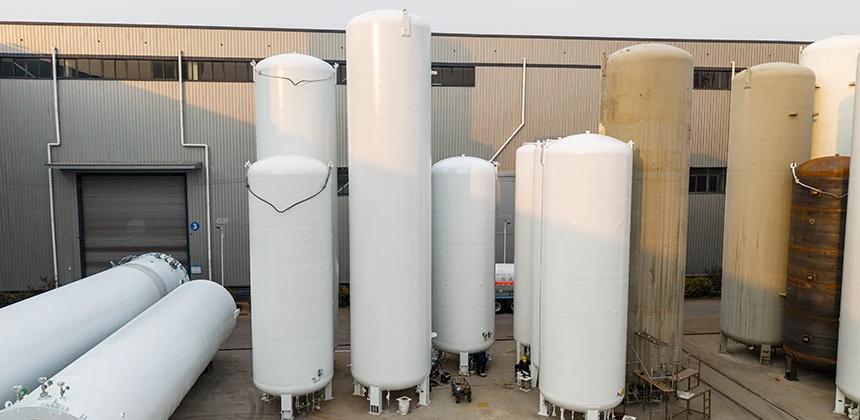
Liquid CO₂ Storage Tank Specifications
The following table shows standard liquid CO₂ storage tank configurations. Tank dimensions, pressure ratings, materials, piping arrangements, and instrumentation can be configured according to project and local regulatory requirements.
| Model | Volume (m³) | Design Pressure (MPa) | Dimensions (mm) | Weight (kg) | Material | Stored Medium |
|---|---|---|---|---|---|---|
| CFL-5/2.16 | 5 | 2.16 | Φ2000 × 5130 | 4450 | Outer: Q245-R / Inner: 16MnDR | LCO₂ |
| CFL-10/2.16 | 10 | 2.16 | Φ2100 × 7170 | 6986 | Outer: Q245-R / Inner: 16MnDR | LCO₂ |
| CFL-15/2.16 | 15 | 2.16 | Φ2500 × 6912 | 8810 | Outer: Q245-R / Inner: 16MnDR | LCO₂ |
| CFL-20/2.16 | 20 | 2.16 | Φ2500 × 8756 | 11328 | Outer: Q245-R / Inner: 16MnDR | LCO₂ |
| CFL-30/2.16 | 30 | 2.16 | Φ2900 × 8875 | 17961 | Outer: Q245-R / Inner: 16MnDR | LCO₂ |
| CFL-50/2.16 | 50 | 2.16 | Φ3200 × 11300 | 26097 | Outer: Q245-R / Inner: 16MnDR | LCO₂ |
| CFL-100/2.16 | 100 | 2.16 | Φ3500 × 16870 | 49627 | Outer: Q245-R / Inner: 16MnDR | LCO₂ |
Note: The specifications above represent standard configurations. Actual dimensions and technical parameters may vary according to the selected design, accessories, applicable standards, and project requirements.
Key Features of DSW Liquid CO₂ Storage Tanks
Vacuum-Insulated Double-Wall Construction
Each liquid CO₂ storage tank uses a double-wall cryogenic vessel design with vacuum insulation to reduce heat transfer from the surrounding environment. Effective insulation helps minimise product evaporation and supports stable long-term storage.
- Reduced heat ingress
- Lower product loss during storage
- Improved storage efficiency
- Suitable for continuous industrial CO₂ supply
Stable Pressure and Safe Operation
Liquid CO₂ storage systems can be equipped with pressure-control and safety components appropriate for the tank configuration and application. Available equipment may include pressure-building systems, safety relief devices, pressure gauges, level instruments, and automated controls.
- Pressure build-up equipment
- Safety relief devices
- Pressure and liquid-level monitoring
- Optional automated PLC control
Industrial Cryogenic Tank Construction
The inner vessel and outer shell are selected according to the applicable design code and operating requirements. DSW provides industrial liquid CO₂ storage solutions designed for demanding operating environments and long-term service.
- Vacuum-insulated inner vessel and outer shell construction
- Material selection according to the tank design
- Pressure and leak testing during manufacturing
- Non-destructive testing where required by the applicable design and inspection requirements
Flexible Storage Capacity
DSW offers standard liquid CO₂ storage tank capacities from 5 m³ to 100 m³. Customers can select an appropriate tank size based on expected CO₂ consumption, delivery frequency, available installation space, and required supply continuity.
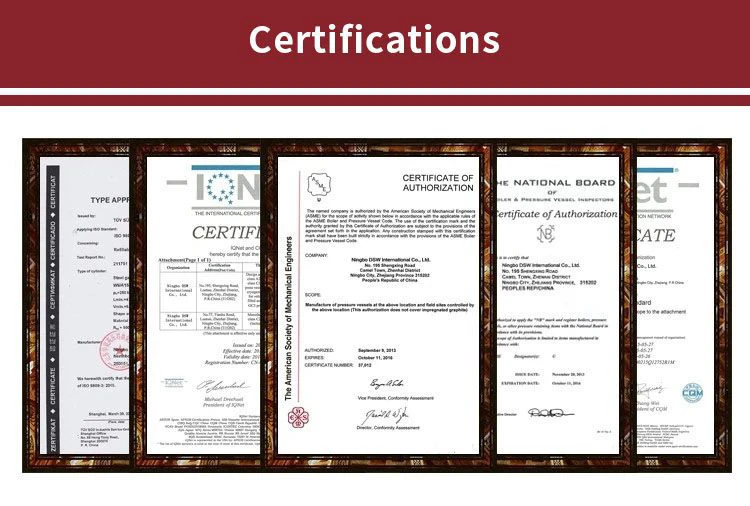
Quality Control and Available Approvals
DSW manufactures liquid CO₂ storage tanks according to the applicable project specifications and relevant pressure vessel requirements. Available certification and third-party inspection options depend on the tank design, destination market, and customer requirements.
- ASME: Available for projects requiring design and fabrication in accordance with applicable ASME pressure vessel requirements.
- European Requirements: Tank designs can be configured to meet relevant European pressure equipment requirements where applicable.
- ISO 9001 Quality Management: Quality management procedures support consistent manufacturing and inspection processes.
- CE / PED Documentation: Available where required for applicable European projects and product configurations.
- Third-Party Inspection: Inspection by organisations such as TÜV or other approved agencies can be arranged when required.
Quality control activities may include material verification, dimensional inspection, welding inspection, non-destructive testing, pressure testing, and vacuum-performance testing according to the applicable design and inspection requirements.
Applications of Liquid CO₂ Storage Tanks
Liquid carbon dioxide storage tanks are used where a dependable bulk supply of CO₂ is required for industrial production, processing, or distribution.
- Food and Beverage: Carbonation, food cooling, freezing, and other CO₂-related processes.
- Dry Ice Production: Bulk liquid CO₂ storage for dry ice manufacturing systems.
- Chemical Processing: CO₂ storage for industrial processes requiring controlled gas supply.
- Welding and Metal Fabrication: Centralised CO₂ storage for shielding gas and mixed-gas supply systems.
- Greenhouse Agriculture: CO₂ storage for controlled atmosphere and greenhouse enrichment systems.
- Other Industrial Applications: Bulk CO₂ supply for facilities with regular or continuous gas consumption.
For projects with smaller or decentralised gas consumption requirements, DSW can also provide MicroBulk gas systems as an alternative to conventional bulk storage installations.
How to Select the Right Liquid CO₂ Storage Tank
Selecting a suitable liquid CO₂ tank involves more than choosing the largest available capacity. DSW can help evaluate the following project factors:
- Average and peak CO₂ consumption
- Required storage capacity and delivery frequency
- Available installation space and site access
- Required operating pressure and supply pressure
- Local regulations and applicable pressure vessel standards
- Required vaporizers, pressure-control equipment, and piping connections
Provide your expected CO₂ consumption and installation requirements, and our technical team can help identify a suitable liquid CO₂ storage tank configuration for your application.
Reviews
There are no reviews yet.