




Cryogenic Liquid Evaporation Rate (Boil-Off Rate)
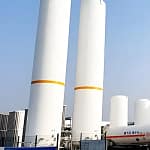
The evaporation rate, commonly referred to as the boil-off rate (BOR), is the percentage of a stored cryogenic liquid that vaporizes per day due to heat ingress. It is a critical performance parameter in vacuum-insulated cryogenic tanks, affecting storage efficiency, pressure stability, and operational cost.
Cryogenic liquids such as liquid nitrogen (LN2), liquid oxygen (LOX), liquid argon (LAr), liquid carbon dioxide (LCO₂), and liquefied natural gas (LNG) are stored at extremely low temperatures. Despite advanced insulation, a controlled level of vaporization is unavoidable due to environmental heat transfer.
Minimizing boil-off is essential for cryogenic storage, LNG storage systems, and cryogenic transport applications, where product retention and energy efficiency are critical.
Factors Affecting Evaporation Rate
The evaporation rate of cryogenic liquids is governed by multiple thermodynamic and design-related factors:
- Vacuum insulation performance: High-vacuum multilayer insulation (MLI) reduces thermal radiation and conductive heat transfer.
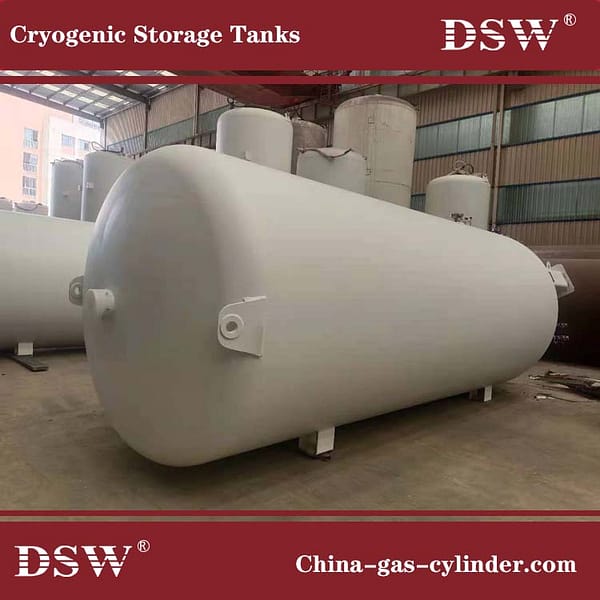
- Tank design and construction: Double-walled vessels with stainless steel inner tanks improve thermal resistance.
- Ambient temperature and climate conditions: Higher temperatures increase external heat load.
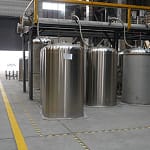
- Surface-area-to-volume ratio: Smaller containers (e.g., cryogenic dewars) experience higher relative evaporation.
- Operating pressure and venting: Pressure build-up and venting cycles influence gas losses.
- Filling level and stratification: Partial fills can increase thermal instability and vapor generation.
Typical Boil-Off Rates for Common Cryogenic Liquids
Boil-off rates vary based on tank size, insulation efficiency, and application (storage vs transport). The following values represent typical industry ranges:
- Liquid Nitrogen (LN2):
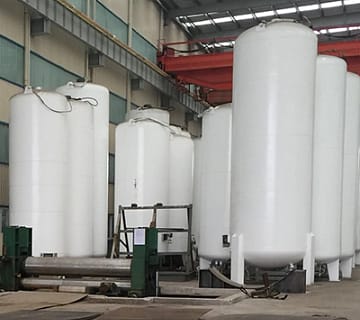
Bulk storage tanks: 0.1% – 0.5% per day
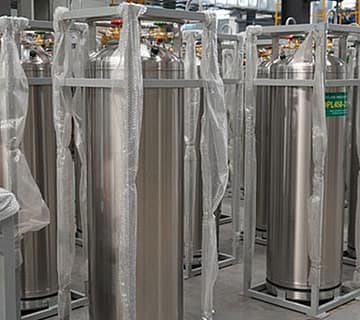
Dewars and small containers: 0.5% – 3% per day - Liquid Oxygen (LOX):
Bulk tanks: 0.1% – 0.5% per day
Smaller vessels: 0.5% – 3% per day - Liquid Argon (LAr):
Bulk tanks: 0.1% – 0.4% per day
Dewars: 1% – 3% per day - Liquid Carbon Dioxide (LCO₂):
Typically <0.1% per day under pressurized and refrigerated conditions - Liquefied Natural Gas (LNG):
0.05% – 0.3% per day in large-scale LNG storage tanks due to advanced insulation systems and optimized tank geometry
These boil-off rates are widely used benchmarks in cryogenic engineering, but actual values depend on insulation quality, tank design, and operating conditions.
Heat Transfer Mechanisms in Cryogenic Storage
Boil-off is driven by three primary modes of heat transfer:
- Conduction: Heat transfer through tank supports and structural components
- Radiation: Thermal radiation between inner and outer vessel walls
- Convection: External air movement contributing to heat gain
Modern cryogenic tanks minimize these effects through vacuum insulation, multilayer insulation (MLI), and optimized structural design.
Boil-Off Rate and Cryogenic Tank Efficiency
The boil-off rate directly determines the efficiency of cryogenic storage systems. Lower BOR values indicate better insulation performance and reduced product loss.
Excessive evaporation may signal:
- Loss of vacuum insulation integrity
- Insulation degradation or moisture ingress
- Mechanical damage to the storage vessel
- Improper handling or frequent pressure cycling
Maintaining low boil-off is essential for gas supply reliability, process stability, and cost control in industrial and LNG applications.
Key Takeaways
- Evaporation rate (BOR) is a key metric for evaluating cryogenic storage performance.
- Bulk tanks offer significantly lower boil-off compared to small dewars.
- Advanced vacuum insulation is essential for minimizing thermal losses.
- Monitoring evaporation helps optimize efficiency, safety, and cost control.
TECHNICAL QUESTIONS
Frequently asked questions About Cryogenic Evaporation Rate
The boil-off rate (BOR) is the percentage of cryogenic liquid that vaporizes daily due to heat ingress. It is a key performance metric used to evaluate insulation efficiency, thermal losses, and overall cryogenic tank performance.
Liquid nitrogen (LN2) typically evaporates at 0.1%–0.5% per day in bulk vacuum-insulated tanks and 0.5%–3% per day in smaller dewars. Actual rates depend on tank design, insulation quality, and operating conditions.
Smaller containers have a higher surface-area-to-volume ratio, increasing heat transfer into the stored liquid. This leads to higher relative evaporation compared to large cryogenic tanks with optimized geometry and insulation systems.
Boil-off can be reduced by using high-performance vacuum insulation, multilayer insulation (MLI), proper tank sizing, minimizing thermal bridges, and maintaining stable operating conditions with limited venting.
Typical LNG boil-off rates range from 0.05% to 0.3% per day, depending on tank size and insulation technology. Large full-containment tanks achieve lower rates due to optimized design and reduced surface-area-to-volume ratios.


No comment