
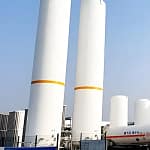
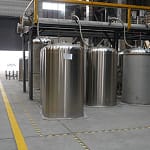
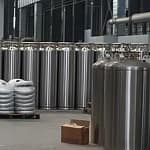
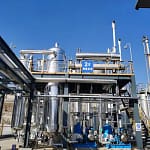


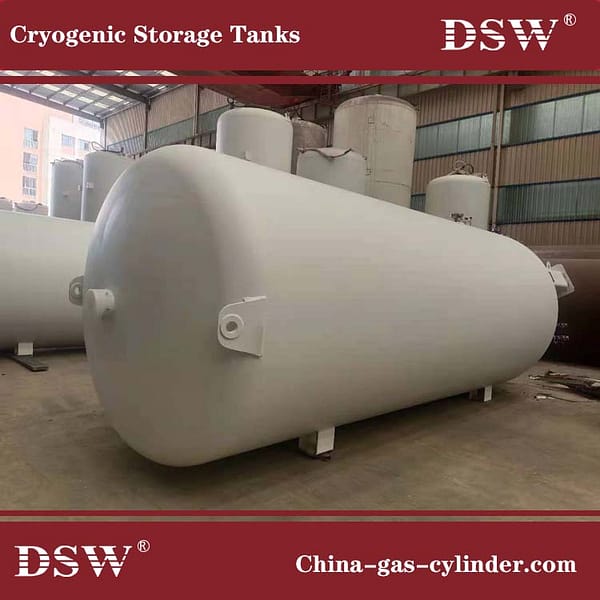

Cryogenic tanks are specialized insulated storage vessels designed to safely store liquefied gases at extremely low temperatures. They are widely used for liquid nitrogen (LN2), liquid oxygen (LOX), liquid argon (LAr), liquefied natural gas (LNG), carbon dioxide, and other industrial gases.For an overview of cryogenic tank types, design, components, standards, and applications, see our cryogenic tanks guide.
Selecting the correct cryogenic tank size is one of the most important decisions for industrial gas users. An undersized tank can result in frequent refilling and operational disruptions, while an oversized tank increases installation costs and space requirements.
This guide explains standard cryogenic tank sizes, storage capacities, dimensions, and practical considerations for selecting the right cryogenic storage system for your application.
Understanding Cryogenic Tank Sizes
Cryogenic tank sizes are usually defined by their storage capacity, measured in liters (L), cubic meters (m³), or gallons (gal). Depending on the application, cryogenic tanks can range from small portable vessels for laboratory use to large industrial storage systems designed for continuous gas supply.
Common cryogenic tank size categories include:
- Portable cryogenic tanks and dewars: Small-capacity containers commonly used for laboratories, medical applications, research, and short-term storage.
- Cryogenic cylinders: Compact vessels designed for storing and transporting liquefied gases such as liquid nitrogen, oxygen, and argon.
- Stationary cryogenic storage tanks: Larger vacuum-insulated tanks installed at industrial facilities to provide continuous gas supply.
- Cryogenic ISO tank containers: Transportable tanks designed for international shipping and bulk cryogenic liquid transportation.
- LNG storage tanks: Specialized cryogenic tanks used for liquefied natural gas storage and distribution.
The right cryogenic tank size depends on several factors, including:
- Required liquid capacity
- Daily gas consumption
- Storage duration
- Transportation requirements
- Available installation space
- Operating pressure
- Vaporization demand
- Safety and regulatory requirements
Understanding cryogenic tank dimensions, capacity, and application requirements helps ensure the selected tank provides reliable performance, efficient operation, and safe storage of cryogenic liquids.
Standard Cryogenic Tank Sizes
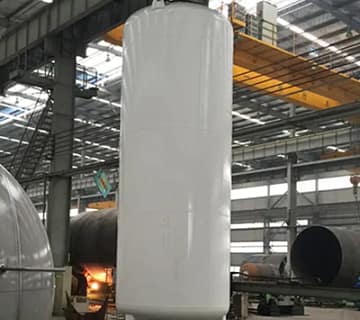
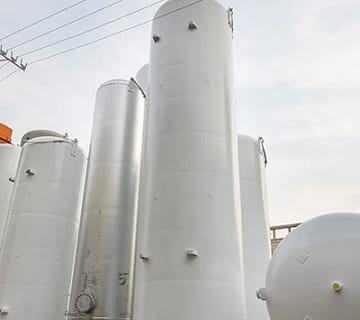
Cryogenic storage tanks are manufactured in a wide range of capacities to accommodate different industries, consumption rates, and installation requirements. Most tanks are vertically mounted and feature a double-wall vacuum-insulated design to minimize heat transfer and reduce product loss.
Standard cryogenic storage tank sizes generally fall into the following categories:
- Small Tanks: 500–3,000 liters
- Medium Tanks: 5,000–20,000 liters
- Large Tanks: 30,000–100,000 liters
- Bulk Storage Tanks: Over 100,000 liters
Smaller tanks are commonly used in laboratories, hospitals, and research facilities, while larger tanks support manufacturing plants, industrial gas distributors, LNG facilities, and energy infrastructure projects.
Common Cryogenic Tank Size Ranges
| Cryogenic Tank Type | Typical Capacity |
|---|---|
| Microbulk Cryogenic Tanks Small-scale storage for laboratories, healthcare, and small industrial users |
500–3,000 L |
| Stationary Bulk Cryogenic Tanks Common industrial storage for continuous gas supply applications |
5,000–20,000 L |
| Industrial Cryogenic Storage Tanks Large capacity systems used in manufacturing and gas distribution |
30,000–100,000 L |
| Bulk Cryogenic Storage Vessels Large-scale storage for LNG facilities and major industrial plants |
100,000 L+ |
Smaller tanks are commonly used in laboratories, hospitals, and research facilities, while larger tanks support manufacturing plants, industrial gas distributors, LNG facilities, and energy infrastructure projects.
Mobile Cryogenic Tank Sizes
Mobile cryogenic tanks are designed for transportation rather than permanent storage.
They include cryogenic tank trailers, ISO tank containers, and portable liquid gas storage systems.
| Mobile Cryogenic Tank Type | Typical Capacity |
|---|---|
| Portable Cryogenic Dewars Laboratory and small-volume applications |
1–500 L |
| Cryogenic Transport Tanks Liquid nitrogen, oxygen, argon transportation |
5,000–60,000 L |
| Cryogenic ISO Tank Containers International gas logistics and LNG transportation |
20–45 m³ |
Cryogenic Tank Capacity Chart
The following cryogenic tank capacity chart provides typical storage capacities and approximate dimensions. Actual dimensions vary depending on manufacturer specifications, working pressure, insulation design, and local regulations.
| Capacity (Liters) | Capacity (m³) | Approx. Diameter | Approx. Height |
|---|---|---|---|
| 500 | 0.5 | 0.8 m | 1.8 m |
| 1,000 | 1.0 | 1.0 m | 2.2 m |
| 3,000 | 3.0 | 1.5 m | 3.5 m |
| 5,000 | 5.0 | 1.8 m | 4.0 m |
| 10,000 | 10.0 | 2.0 m | 5.0 m |
| 20,000 | 20.0 | 2.4 m | 6.5 m |
| 30,000 | 30.0 | 2.8 m | 8.0 m |
| 50,000 | 50.0 | 3.2 m | 10.0 m |
| 100,000 | 100.0 | 3.8 m | 15.0 m |
These figures provide a general reference for planning site layout, transportation logistics, and installation requirements.
Small-to-Medium Tanks (120–1,000 gal / 450–3,800 L)
| Capacity | Liters | Typical Applications |
|---|---|---|
| 120 gal | 450 L | Small labs, specialty gases |
| 250 gal | 950 L | Medical oxygen backup, welding |
| 500 gal | 1,900 L | Light industrial facilities |
| 1,000 gal | 3,800 L | Medium commercial operations |
Best For: Moderate daily gas usage, limited space, and periodic deliveries.
Large Tanks (2,000–6,000 gal / 7,600–22,700 L)
| Capacity | Liters | Typical Applications |
|---|---|---|
| 2,000 gal | 7,600 L | Large industrial plants |
| 4,000 gal | 15,000 L | Centralized gas supply sites |
| 6,000 gal+ | 22,700 L | Continuous industrial operations |
Best For: High-volume operations, industrial gas distribution, energy facilities.
Extra-Large & Custom Tanks (10,000 gal+ / 37,850 L+)
Custom solutions are designed for high-demand industrial sites or LNG fueling stations. Features may include:
- Dual compartments
- High-pressure operation
- Specialized fittings for automated distribution
Detailed Cryogenic Tank Size Chart (LOX, LIN, LAr)
The following table provides typical specifications for vacuum powder insulated cryogenic storage tanks used for liquid nitrogen (LIN/LN2), liquid oxygen (LOX), and liquid argon (LAr) applications.
Tank capacity, working pressure, evaporation rate, weight, and dimensions vary depending on design standards and manufacturer specifications.
| Tank Model | Capacity | Working Pressure | Static Evaporation | Application |
|---|---|---|---|---|
| V-5 | 5 m³ | 0.8–1.6 MPa | ≈0.43%/day | Small industrial gas storage |
| V-10 | 10 m³ | 0.8–1.6 MPa | ≈0.36%/day | Factories and gas supply systems |
| V-20 | 20 m³ | 0.8–1.6 MPa | ≈0.33%/day | Medium bulk cryogenic storage |
| V-30 | 30 m³ | 0.8–1.6 MPa | ≈0.29%/day | Industrial gas distribution |
| V-50 | 50 m³ | 0.8–1.6 MPa | ≈0.23%/day | Large industrial storage |
| V-100 | 100 m³ | 0.8–1.6 MPa | ≈0.16%/day | Bulk gas storage facilities |
Typical Cryogenic Tank Dimensions
Cryogenic tank dimensions depend on capacity, working pressure, insulation type, and design requirements. Larger tanks usually provide lower static evaporation rates because of improved surface-area-to-volume efficiency.
- 5 m³ tanks: approximately 1.9–2.2 m diameter
- 10–20 m³ tanks: approximately 2.2–2.6 m diameter
- 30–50 m³ tanks: approximately 3.0–3.2 m diameter
- 100 m³ tanks: approximately 3.6 m diameter
Horizontal Cryogenic Tank Sizes (LOX, LN2 & LAr)
Horizontal cryogenic tanks are vacuum powder insulated storage vessels designed for the safe storage of liquid oxygen (LOX), liquid nitrogen (LN2), and liquid argon (LAr).
Compared with vertical cryogenic tanks, horizontal tanks are often selected where installation height is limited or where transportation and site layout require a horizontal configuration.
The following horizontal cryogenic tank size chart shows typical capacities, working pressures, evaporation rates, and approximate dimensions.
Actual specifications may vary depending on design standards, materials, and manufacturer requirements.
Horizontal Cryogenic Tank Capacity Chart
| Tank Model | Capacity | Working Pressure | Static Evaporation | Typical Application |
|---|---|---|---|---|
| H-5 | 5 m³ | 0.8–1.6 MPa | ≈0.43%/day | Small industrial gas storage |
| H-10 | 10 m³ | 0.8–1.6 MPa | ≈0.36%/day | Factories and medical gas systems |
| H-20 | 20 m³ | 0.8–1.6 MPa | ≈0.33%/day | Medium bulk cryogenic storage |
| H-30 | 30 m³ | 0.8–1.6 MPa | ≈0.29%/day | Industrial gas supply |
| H-50 | 50 m³ | 0.8–1.6 MPa | ≈0.23%/day | Large industrial storage |
| H-100 | 100 m³ | 0.8–1.6 MPa | ≈0.16%/day | Bulk gas storage facilities |
Horizontal Cryogenic Tank Dimensions
Cryogenic tank dimensions depend on storage capacity, working pressure, and insulation design. Larger tanks usually provide better storage efficiency because heat transfer losses decrease as tank volume increases.
- 5 m³ horizontal tanks: approximately Φ1900 mm diameter × 5 m length
- 10 m³ horizontal tanks: approximately Φ2200 mm diameter × 6.2 m length
- 20 m³ horizontal tanks: approximately Φ2600 mm diameter × 7.8 m length
- 30 m³ horizontal tanks: approximately Φ3000 mm diameter × 8.7 m length
- 50 m³ horizontal tanks: approximately Φ3200 mm diameter × 11.8 m length
- 100 m³ horizontal tanks: approximately Φ3500–3600 mm diameter × 16.8 m length
Horizontal vs Vertical Cryogenic Tanks
Horizontal and vertical cryogenic tanks are both widely used for liquid nitrogen (LN2), liquid oxygen (LOX), and liquid argon (LAr) storage.
The best choice depends on installation space, capacity requirements, maintenance access, and operating conditions.
| Comparison | Horizontal Cryogenic Tanks | Vertical Cryogenic Tanks |
|---|---|---|
| Installation Space | Suitable for locations with limited height and larger ground area availability | Requires less floor space but needs sufficient installation height |
| Typical Applications | Industrial plants, gas supply stations, transportation-related storage systems | Hospitals, factories, laboratories, and permanent bulk storage facilities |
| Capacity Range | Commonly available from small to large bulk storage capacities | Available from microbulk tanks to large industrial storage tanks |
| Maintenance Access | Generally provides easier access to valves, piping, and connections | Requires vertical access planning for maintenance and inspection |
| Ground Area | Needs more horizontal installation area | Requires smaller foundation footprint |
| Best Choice When | Building height is limited or horizontal layout is preferred | Space efficiency and long-term stationary storage are priorities |
LCO₂ Cryogenic Tank Sizes (Liquid CO₂ Storage Tanks)
LCO₂ cryogenic tanks are vacuum insulated storage vessels designed for liquid carbon dioxide storage.
They are commonly used in food processing, beverage carbonation, welding, water treatment, and industrial gas supply systems.
Typical liquid CO₂ tank sizes range from 5 m³ to 100 m³. Tank selection depends on CO₂ consumption, storage duration, working pressure, and installation space.
LCO₂ Tank Capacity Chart
| Tank Size | Capacity | Working Pressure | Application |
|---|---|---|---|
| V-5 | 5 m³ | 2.16 MPa | Small CO₂ storage |
| V-10 / V-20 | 10–20 m³ | 2.16 MPa | Industrial CO₂ supply |
| V-30 / V-50 | 30–50 m³ | 2.16 MPa | Bulk liquid CO₂ storage |
| V-100 | 100 m³ | 2.16 MPa | Large CO₂ facilities |
LCO₂ Tank Dimensions
Liquid CO₂ cryogenic tank dimensions increase with capacity. Typical vertical LCO₂ storage tank dimensions include:
- 5 m³: approximately Φ1900 × 5 m
- 10–20 m³: approximately Φ1900–2200 × 5–7 m
- 30–50 m³: approximately Φ2400–2600 × 7–10 m
- 100 m³: approximately Φ3000 × 15 m
LNG Cryogenic Tank Sizes
LNG cryogenic tanks are vacuum insulated storage vessels designed for liquefied natural gas (LNG) storage at approximately -162°C.
Common applications include LNG fueling stations, industrial gas supply, and energy storage systems.
LNG Tank Capacity Chart
| Tank Size | Capacity | Working Pressure | Static Evaporation |
|---|---|---|---|
| V-5 | 5 m³ | 0.8 MPa | ≈0.65%/day |
| V-10 | 10 m³ | 0.8 MPa | ≈0.55%/day |
| V-20 | 20 m³ | 0.8 MPa | ≈0.50%/day |
| V-30 | 30 m³ | 0.8 MPa | ≈0.44%/day |
| V-50 | 50 m³ | 0.8 MPa | ≈0.35%/day |
| V-100 | 100 m³ | 0.8 MPa | ≈0.25%/day |
LNG Storage Tank Dimensions
Typical LNG cryogenic tank dimensions increase with capacity. Larger tanks usually achieve lower evaporation losses through improved volume efficiency.
- 5 m³: Φ1900 × 5115 mm
- 10 m³: Φ2200 × 6400 mm
- 20 m³: Φ2600 × 7955 mm
- 30 m³: Φ3000 × 8930 mm
- 50 m³: Φ3200 × 12000 mm
- 100 m³: Φ3600 × 17260 mm
LNG Cryogenic Tank Design Features
- Vacuum powder insulation structure
- Low-temperature inner vessel for LNG storage
- Low static evaporation rate
- Helium leak testing
- Designed for safe LNG transportation and storage
Selecting the correct LNG tank size depends on LNG consumption, storage duration, refill frequency, installation space, and future capacity requirements.
How to Select the Right Cryogenic Tank Size
Choosing the correct cryogenic tank size requires evaluating operational needs, gas consumption, delivery frequency, available space, and future expansion plans.
1. Calculate Daily Consumption
Determine your average daily usage of liquid nitrogen, oxygen, argon, LNG, or other cryogenic liquids. This provides the foundation for estimating storage requirements.
2. Consider Delivery Frequency
Facilities receiving weekly deliveries generally require larger storage capacity than facilities with more frequent deliveries.
3. Plan for Future Growth
Many industrial facilities increase gas consumption over time. Selecting a larger tank today can reduce future upgrade costs.
4. Evaluate Installation Space
Tank dimensions, safety clearances, maintenance access, and foundation requirements should all be considered during site planning.
5. Review Regulatory Requirements
Local codes and industry standards may affect tank placement, safety distances, and system design.
6. Compare Total Cost of Ownership
The lowest initial cost does not always provide the best long-term value. Properly sized cryogenic tanks can reduce transportation costs, minimize downtime, and improve operational efficiency.
Applications of Different Cryogenic Tank Sizes
Different cryogenic tank sizes are designed to meet specific industry requirements based on gas demand, operational scale, and storage duration.
- Small tanks (120–500 gal): Used in laboratories, medical facilities, and specialty gas applications requiring compact and flexible storage.
- Medium tanks (1,000–2,000 gal): Suitable for food processing, welding operations, and small industrial plants with moderate gas consumption.
- Large tanks (4,000–6,000+ gal): Ideal for continuous industrial manufacturing, metal processing, and bulk gas supply systems.
- Custom large tanks (10,000+ gal): Common in LNG fueling stations, petrochemical plants, and large-scale energy infrastructure.
Selecting the correct tank size ensures efficient gas utilization, reduced delivery frequency, and improved operational reliability across applications.
TECHNICAL FAQs
About Cryogenic Tank Sizes
The most common cryogenic tank sizes include 3,000 L, 5,000 L, 10,000 L, 20,000 L, 30,000 L, and 50,000 L. Larger industrial cryogenic storage tanks can exceed 100,000 liters.
Cryogenic tank capacity is usually calculated based on daily liquid gas consumption, required storage duration, delivery frequency, and reserve capacity. The selected tank size should also consider future demand growth.
Cryogenic tank capacity refers to the amount of liquid gas the tank can store, usually measured in liters or cubic meters. Tank dimensions refer to the physical size, including diameter and height.
The required liquid nitrogen tank size depends on nitrogen consumption, refill schedule, operating conditions, and available installation space. Industrial users commonly select tanks from 10,000 L to 30,000 L or larger.
Typical liquid oxygen tank sizes range from 1,000 L to 100,000 L. Hospitals often use smaller tanks, while industrial facilities may require larger bulk oxygen storage systems.
Common LNG tank sizes include 5 m³, 10 m³, 20 m³, 30 m³, 50 m³, 100 m³, and larger storage systems for industrial and energy applications.
The right cryogenic storage tank size depends on gas consumption, required storage time, delivery frequency, site space, safety requirements, and future expansion needs.
Conclusion
Selecting the correct cryogenic tank sizes ensures safety, efficiency, and cost-effectiveness. From small lab tanks (120 gal) to custom 10,000 + gal industrial tanks, understanding your gas demand, site limitations, and operational goals is critical.
Properly sized stationary cryogenic tanks minimize boil-off losses, optimize delivery logistics, and ensure uninterrupted gas supply for industrial, medical, and energy applications.

No comment