




A Technical Guide to Cryogenic Storage, Pressure Control, and Industrial Applications
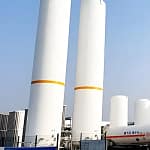
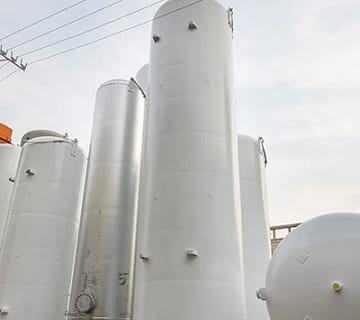
Liquid oxygen (LOX) tanks are advanced cryogenic storage systems used to safely store and deliver oxygen at extremely low temperatures. These tanks are widely used in hospitals, steel plants, and aerospace systems, where a stable and high-volume oxygen supply is critical.These systems are part of broader cryogenic equipment systems used across industrial gas infrastructure, where pressure control and thermal insulation play a key role.
This guide explains how LOX tanks actually work in real-world systems, including pressure control, vaporization, and safety mechanisms based on industrial practice. For a broader overview of cryogenic tank types, design, sizing, and applications, see our cryogenic tanks guide.
What Is Liquid Oxygen (LOX)?
Liquid oxygen is oxygen cooled to −183°C (−297°F), where it becomes a dense cryogenic liquid.
Key Engineering Properties:
- Expansion ratio: 1:860 (liquid to gas)
- Storage state: Saturated cryogenic liquid
- Typical storage pressure: 2–20 bar (29–290 psi) depending on tank design
- Strong oxidizer (non-flammable but supports combustion)
Structure of a Liquid Oxygen Tank
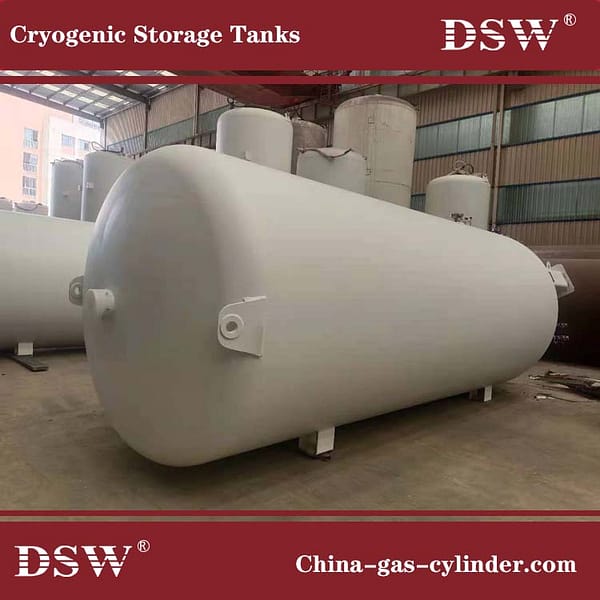
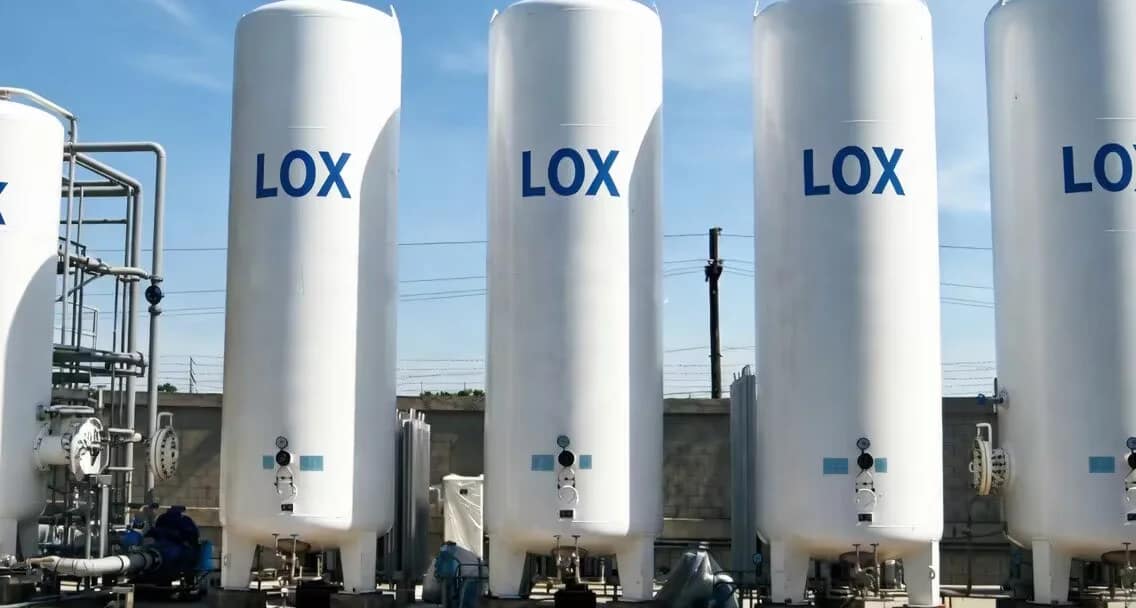
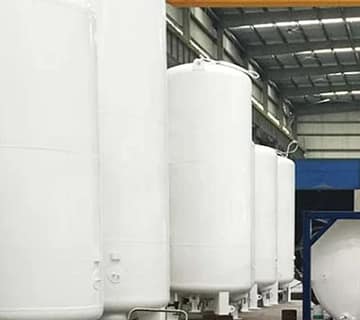
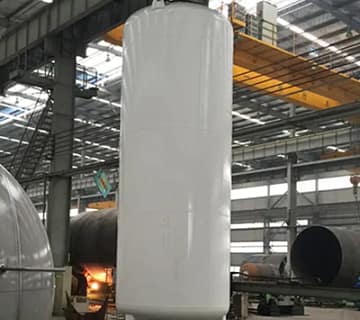
A LOX tank is a double-walled, vacuum-insulated pressure vessel designed to minimize heat transfer.
Core Components:
Inner Vessel
Material: Austenitic stainless steel (e.g., 304/316)
Designed for cryogenic compatibility
Outer Vessel
Carbon steel with protective coating
Provides structural strength
Vacuum Insulation System
High vacuum (10⁻³ mbar range)
Multi-layer insulation reduces heat ingress
Piping & Valves System
Liquid withdrawal line
Gas withdrawal line
Pressure build-up circuit
Safety System
Pressure Relief Valve (PRV)
Rupture disc (backup protection)
How LOX Tanks Work (Step-by-Step)
1. Cryogenic Storage
LOX is stored at low temperature in a saturated state.
The vacuum insulation slows heat transfer but cannot eliminate it completely.
2. Heat Leak & Boil-Off Gas (BOG)
A small heat leak causes part of the liquid oxygen to evaporate:
- This creates Boil-Off Gas (BOG)
- BOG increases internal pressure naturally
👉 This is a key principle: LOX tanks are self-pressurizing systems
3. Pressure Build-Up System (PBU)
To maintain stable pressure, tanks use a Pressure Build-Up Unit:
- A small amount of LOX is diverted
- Passed through a vaporizer coil
- Converted into gas
- Returned to the tank to increase pressure
This ensures:
- Stable delivery pressure
- No need for external compressors (in many systems)
4. Pressure Control & Regulation
Typical operating pressure ranges:
- Cryogenic cylinders: 8–16 bar
- Bulk tanks: 2–10 bar
Control methods:
- Automatic pressure regulators
- Pressure relief valves (release excess gas)
- Economizer circuits (optimize gas usage)
5. Oxygen Withdrawal
LOX tanks supply oxygen in two modes:
Gas Withdrawal (Most Common)
Liquid passes through an ambient vaporizer
Converts into gas before use
Liquid Withdrawal
Used for industrial processes requiring liquid oxygen
Requires insulated transfer lines
Key Supporting Equipment
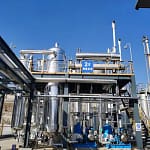
Vaporizers
Convert LOX into gas using ambient air or steam:
- Ambient vaporizers (most common)
- Steam vaporizers (high-demand systems)
Economizer System
- Uses excess pressure gas first
- Reduces product loss
- Improves efficiency
Types of LOX Tanks (Industrial Classification)
| Type | Capacity | Application |
|---|---|---|
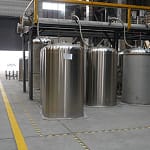
| Cryogenic Cylinder | 150–500 L | Labs, medical |
| Microbulk Tank | 1,000–20,000 L | Hospitals, SMEs |
| Bulk Storage Tank | 20,000–200,000+ L | Steel, petrochemical |
LOX vs LIN vs LAR: Key Differences in Cryogenic Storage
In cryogenic storage systems, liquid oxygen (LOX), liquid nitrogen (LIN), and liquid argon (LAR) are the three most commonly stored industrial gases. While they use similar tank designs, their properties, applications, and safety considerations differ significantly.
| Property | LOX (Liquid Oxygen) | LIN (Liquid Nitrogen) | LAR (Liquid Argon) |
|---|---|---|---|
| Boiling Point | −183°C | −196°C | −186°C |
| Primary Function | Oxidizer (supports combustion) | Inert cooling & preservation | Inert shielding gas |
| Chemical Reactivity | Highly reactive (oxidizing) | Inert | Inert |
| Main Applications | Medical, steelmaking, aerospace | Food freezing, cryopreservation | Welding, electronics, metallurgy |
| Safety Risk | Fire acceleration risk | Asphyxiation risk | Asphyxiation risk |
| Storage Similarity | All stored in vacuum-insulated cryogenic tanks with pressure control systems | ||
Real-World Applications
Medical Oxygen Supply
Central oxygen systems in hospitals
Backup oxygen storage
Steel Manufacturing
Oxygen injection in blast furnaces
Improves combustion efficiency
Aerospace Industry
LOX used as oxidizer in rocket engines
Environmental Engineering
Wastewater oxygenation systems
Safety Considerations (Critical)
Liquid oxygen is a high-risk industrial gas if improperly handled.
Key Risks:
- Oxygen enrichment → fire hazard
- Cryogenic burns
- Pressure explosion risk
Best Practices:
- Use oxygen-compatible materials (no oil/grease)
- Ensure proper ventilation
- Install redundant pressure relief systems
- Follow standards such as:
- ISO 21013 (cryogenic vessels)
- CGA guidelines
Advantages
- High storage density (860× gas volume)
- Lower transport cost
- Continuous supply capability
- Suitable for automation and large-scale systems
Expert Insight
In industrial installations, the most common operational issue is pressure instability, usually caused by:
- Improper PBU tuning
- Excessive vaporization demand
- Poor insulation vacuum
Optimizing these parameters can significantly improve:
- Oxygen delivery stability
- Product loss (BOG reduction)
- System lifespan
TECHNICAL QUESTIONS
FAQs About How Liquid Oxygen Tanks Work
Liquid oxygen tanks store oxygen at cryogenic temperatures around −183°C in vacuum-insulated vessels. A small amount of heat causes part of the liquid to evaporate, creating pressure that pushes oxygen out of the tank. Pressure is controlled using pressure build-up systems, regulators, and relief valves.
The typical operating pressure of a liquid oxygen tank ranges from 2 to 20 bar depending on the tank size and design. Cryogenic cylinders usually operate at higher pressures, while large bulk tanks operate at lower pressures.
LOX tanks build pressure due to heat leak from the environment. This heat causes a portion of the liquid oxygen to vaporize into gas, known as boil-off gas, which increases the internal pressure of the tank.
A pressure build-up unit is a system that vaporizes a small amount of liquid oxygen and returns it as gas to the tank to maintain the required pressure for stable operation and oxygen delivery.
Boil-off gas is the gaseous oxygen produced when a small portion of liquid oxygen evaporates due to heat entering the tank. This process is unavoidable and is used to help maintain internal pressure.
LOX (liquid oxygen) is an oxidizer that supports combustion, while LIN (liquid nitrogen) and LAR (liquid argon) are inert gases. All are stored in similar cryogenic tanks, but their applications and safety considerations differ.
Conclusion
Liquid oxygen tanks operate through a combination of cryogenic storage, natural vaporization, and controlled pressure systems. Their ability to self-pressurize and deliver oxygen efficiently makes them essential across multiple industries.
A properly designed LOX system ensures:
- Stable pressure
- Minimal product loss
- Maximum operational safety

No comment