





Gas cylinders are available in a wide range of sizes to safely store and transport compressed and liquefied gases. Selecting the correct gas cylinder size is important for safe handling, efficient storage, transportation, and continuous gas supply.
Different industries use standardized industrial cylinder sizes to ensure compatibility with regulators, manifolds, gas cabinets, cylinder racks, and filling systems. Cylinder selection normally depends on several factors, including water capacity, gas volume, working pressure, cylinder dimensions, gas type, and application requirements.
Industries including manufacturing, healthcare, laboratories, electronics, food processing, welding, and energy production rely on suitable cylinder sizes to maintain reliable gas supply systems.
This guide explains standard gas cylinder sizes, industrial cylinder dimensions, capacity charts, applications, and how to select the right cylinder for different gases such as oxygen, nitrogen, argon, hydrogen, helium, and carbon dioxide.
What Are Standard Gas Cylinder Sizes?
Standard gas cylinder sizes refer to commonly manufactured cylinders designed for storing gases under high pressure.
Cylinder sizes are mainly classified according to:
- Water capacity (liters)
- Compressed gas capacity (m³)
- Cylinder diameter
- Cylinder height
- Working pressure
The most common industrial cylinder sizes range from 5 liters to 50 liters. Larger cylinders and cylinder bundles are also available for applications requiring higher gas volumes.
Common gases stored in high-pressure cylinders include:
- Oxygen
- Nitrogen
- Argon
- Carbon dioxide
- Hydrogen
- Helium
Each gas requires suitable materials, pressure ratings, and safety standards according to its physical properties.
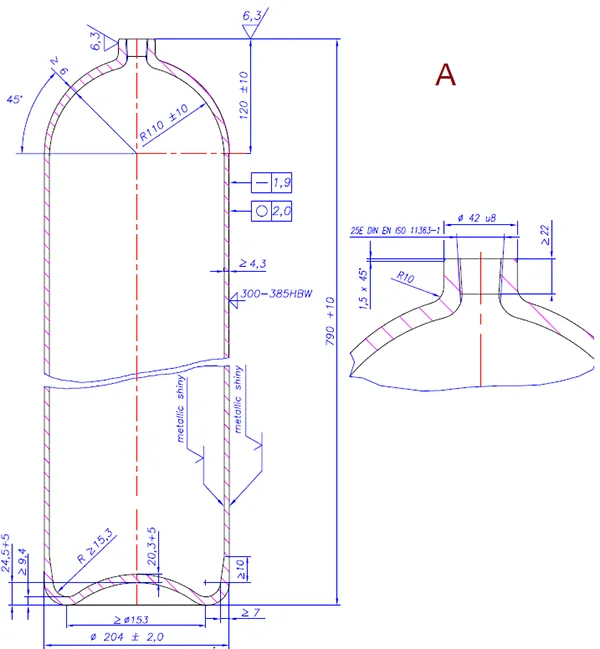
Common Gas Cylinder Sizes
Gas cylinders can be grouped according to their capacity and intended application.
Small cylinders are generally used for:
- Portable oxygen supply
- Laboratory gases
- Calibration gases
- Emergency breathing systems
Large cylinders are commonly used for:
- Industrial gas supply
- Manufacturing processes
- Welding applications
- Gas distribution systems
For industrial applications requiring reliable cylinder performance, BluNet supplies seamless steel gas cylinders manufactured according to international requirements, including ISO 9809 standards.
Industrial Gas Cylinder Size Chart
The table below shows common industrial gas cylinder sizes, including water capacity, approximate gas volume, dimensions, and typical applications.
Gas cylinder capacity depends on filling pressure, gas type, and cylinder design. Many seamless steel cylinders used for industrial gases are manufactured according to international standards such as ISO 9809, which defines requirements for refillable seamless steel gas cylinders, including design, manufacturing, and testing requirements. :contentReference[oaicite:0]{index=0}
| Cylinder Size | Water Capacity (L) | Gas Capacity (m³ @ 200 bar) | Diameter (mm) | Height (mm) | Working Pressure | Typical Application |
|---|---|---|---|---|---|---|
| 5 L | 5 | 0.75 | 140 | 540 | 150–200 bar | Laboratory gases |
| 10 L | 10 | 1.5 | 140 | 930 | 150–200 bar | Medical oxygen and portable gases |
| 20 L | 20 | 3.0 | 203 | 980 | 200 bar | Industrial gas supply |
| 30 L | 30 | 4.5 | 232 | 1150 | 200 bar | Industrial applications |
| 40 L | 40 | 6.0 | 232 | 1315 | 200–300 bar | Welding, manufacturing, industrial gases |
| 47 L | 47 | 7.0 | 232 | 1400 | 200–300 bar | European standard industrial cylinders |
| 50 L | 50 | 7.5 | 232 | 1500 | 200–300 bar | High-volume industrial gas supply |
Note: Gas volume is approximate and varies depending on filling pressure, temperature, and gas properties.
Gas Cylinder Size Mega Chart (20+ Standard Sizes)
For engineers, distributors, and purchasing managers, the following gas cylinder size chart provides a wider comparison of common cylinder capacities used worldwide.
These sizes are commonly applied in medical gas systems, laboratories, welding operations, electronics manufacturing, food processing, and industrial gas distribution.
| Cylinder Size | Water Capacity | Approx. Gas Capacity @ 200 bar | Diameter | Height | Main Application |
|---|---|---|---|---|---|
| 1 L | 1 L | 0.15 m³ | 80 mm | 250 mm | Calibration gases |
| 2 L | 2 L | 0.30 m³ | 100 mm | 430 mm | Portable oxygen |
| 3 L | 3 L | 0.45 m³ | 110 mm | 450 mm | Medical applications |
| 5 L | 5 L | 0.75 m³ | 140 mm | 540 mm | Laboratory gases |
| 6 L | 6 L | 0.90 m³ | 140 mm | 600 mm | Portable gas supply |
| 8 L | 8 L | 1.20 m³ | 140 mm | 700 mm | Portable industrial gases |
| 10 L | 10 L | 1.50 m³ | 140 mm | 930 mm | Medical and laboratory gases |
| 12 L | 12 L | 1.80 m³ | 159 mm | 950 mm | Breathing air and diving |
| 15 L | 15 L | 2.20 m³ | 180 mm | 960 mm | SCUBA cylinders |
| 20 L | 20 L | 3.00 m³ | 203 mm | 980 mm | Industrial gases |
| 25 L | 25 L | 3.80 m³ | 219 mm | 1050 mm | Gas distribution |
| 30 L | 30 L | 4.50 m³ | 232 mm | 1150 mm | Industrial storage |
| 35 L | 35 L | 5.30 m³ | 232 mm | 1220 mm | Manufacturing |
| 40 L | 40 L | 6.00 m³ | 232 mm | 1315 mm | Standard industrial cylinder |
| 45 L | 45 L | 6.80 m³ | 232 mm | 1380 mm | High-volume supply |
| 47 L | 47 L | 7.00 m³ | 232 mm | 1400 mm | European cylinder standard |
| 50 L | 50 L | 7.50 m³ | 232 mm | 1500 mm | Bulk industrial gases |
| 60 L | 60 L | 9.00 m³ | 267 mm | 1600 mm | Cylinder storage banks |
| 80 L | 80 L | 12.00 m³ | 300 mm | 1700 mm | Cylinder bundles |
| 100 L | 100 L | 15.00 m³ | 350 mm | 1800 mm | Large industrial storage |
Gas Cylinder Sizes by Gas Type
Different gases require different cylinder specifications depending on gas properties, storage pressure, application, and safety requirements.
Although many industrial gases use similar cylinder sizes, the preferred capacity can vary depending on consumption rate and operating environment.
The table below shows common cylinder sizes used for different industrial gases.
| Gas Type | Common Cylinder Sizes | Typical Applications |
|---|---|---|
| Oxygen (O₂) | 10 L, 20 L, 40 L, 50 L | Medical oxygen, welding, cutting, industrial processes |
| Nitrogen (N₂) | 20 L, 40 L, 47 L, 50 L | Electronics manufacturing, pressure testing, inert gas supply |
| Argon (Ar) | 20 L, 40 L, 50 L | TIG welding, metal fabrication, specialty gases |
| Carbon Dioxide (CO₂) | 10 L, 20 L, 40 L, 50 L | Food processing, beverage carbonation, industrial applications |
| Hydrogen (H₂) | 40 L, 50 L | Energy applications, laboratories, chemical processes |
| Helium (He) | 10 L, 20 L, 40 L | Laboratories, leak detection, scientific applications |
40L Gas Cylinder Dimensions and Capacity
The 40L gas cylinder is one of the most widely used industrial cylinder sizes worldwide. It provides a good balance between gas storage capacity, transportation convenience, and handling efficiency.
40L cylinders are commonly used for:
- Argon welding gas
- Oxygen supply
- Nitrogen storage
- Industrial gas distribution
- Manufacturing processes
Typical specifications of a 40L industrial gas cylinder:
| Parameter | Typical Specification |
|---|---|
| Water Capacity | 40 Liters |
| Gas Capacity | Approximately 6 m³ at 200 bar |
| Outside Diameter | 232 mm |
| Height | Approximately 1315 mm |
| Working Pressure | 200 bar – 300 bar |
| Material | Seamless steel |
For projects requiring customized dimensions, BluNet provides seamless steel gas cylinders with different capacities, pressures, valve configurations, and certification requirements.
Gas Cylinder Capacity Explained
The capacity of a gas cylinder is normally described using two measurements:
- Water capacity: The internal volume of the empty cylinder measured in liters.
- Gas capacity: The amount of compressed gas available after expansion to atmospheric pressure.
For example:
- A 40L cylinder filled at 200 bar contains approximately 8 m³ of gas after expansion.
- A 50L cylinder filled at 200 bar contains approximately 10 m³ of gas after expansion.
Higher filling pressures such as 300 bar allow cylinders to store more gas without increasing the physical cylinder size.
However, higher-pressure cylinders require suitable materials, manufacturing processes, inspection, and testing according to applicable standards. International standards such as ISO 9809 specify requirements for refillable seamless steel gas cylinders, including design, construction, manufacturing, and testing.
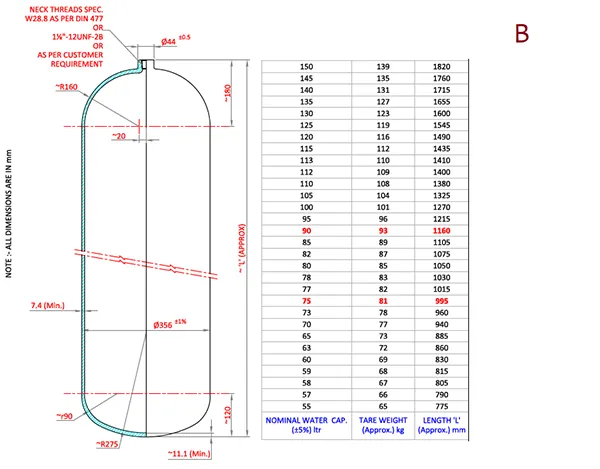
Standard Industrial Cylinder Dimensions
Industrial gas cylinder dimensions vary depending on capacity and pressure rating.
Common ranges include:
| Parameter | Typical Range |
|---|---|
| Cylinder Diameter | 140 mm – 232 mm |
| Cylinder Height | 500 mm – 1500 mm |
| Water Capacity | 5 L – 50 L |
| Working Pressure | 150 bar – 300 bar |
How to Choose the Right Gas Cylinder Size
Selecting the correct gas cylinder size depends on several operational factors. The ideal cylinder should provide enough gas capacity while remaining practical for storage, transportation, and daily operation.
The main factors to consider include:
1. Gas Consumption Rate
Facilities with high gas consumption usually require larger cylinders or multiple cylinders connected through a manifold system.
For example:
- Large manufacturing plants may use 40L or 50L cylinders.
- Laboratories may prefer smaller 5L to 20L cylinders.
- Portable applications usually require compact cylinders.
2. Available Storage Space
Storage area limitations can affect cylinder selection.
Smaller cylinders are easier to handle in limited spaces, while larger cylinders reduce replacement frequency and improve operational efficiency.
For facilities requiring continuous gas supply, alternatives such as industrial gas supply systems or cylinder banks may be more suitable.
3. Transportation Requirements
Portable gas users often select smaller cylinder sizes because they are easier to move and handle.
Industrial users transporting cylinders frequently may choose standardized cylinder dimensions compatible with:
- Cylinder pallets
- Storage racks
- Transport carts
- Gas distribution systems
4. Pressure Requirements
Higher-pressure cylinders can store more gas without increasing physical dimensions.
Common industrial cylinders are available in:
- 150 bar
- 200 bar
- 300 bar
The correct pressure rating depends on the gas type, application, valve specification, and regulatory requirements.
Typical Applications of Industrial Cylinder Sizes
Different industries select cylinder sizes according to gas consumption and operating requirements.
| Industry | Common Cylinder Sizes | Typical Gas Applications |
|---|---|---|
| Medical | 2 L – 10 L | Oxygen therapy and medical gases |
| Laboratories | 5 L – 20 L | Calibration gases and research gases |
| Welding & Fabrication | 40 L – 50 L | Argon, oxygen, and shielding gases |
| Food & Beverage | 20 L – 50 L | CO₂ and nitrogen applications |
| Electronics Manufacturing | 10 L – 47 L | High-purity nitrogen and specialty gases |
| Energy & Chemical Industry | 40 L – 100 L | Hydrogen and industrial process gases |
Industrial Gas Cylinder Standards
Gas cylinders must comply with strict international standards to ensure safe operation under high pressure.
Common standards include:
- ISO 9809 – Seamless steel gas cylinders for compressed, liquefied, and dissolved gases.
- EN 1964 – European requirements for transportable refillable gas cylinders.
- DOT 3AA – United States high-pressure steel cylinder specifications.
- TPED – European Transportable Pressure Equipment Directive requirements.
ISO 9809 standards define requirements related to cylinder materials, design, manufacturing processes, examination, and testing for refillable seamless steel cylinders. :contentReference[oaicite:0]{index=0}
These standards help ensure cylinder safety, durability, and compatibility with international gas supply systems.
Industrial Gas Cylinder Standards
Gas cylinders must comply with strict international standards to ensure safe operation under high pressure.
Common standards include:
- ISO 9809 – Seamless steel gas cylinders for compressed, liquefied, and dissolved gases.
- EN 1964 – European requirements for transportable refillable gas cylinders.
- DOT 3AA – United States high-pressure steel cylinder specifications.
- TPED – European Transportable Pressure Equipment Directive requirements.
ISO 9809 standards define requirements related to cylinder materials, design, manufacturing processes, examination, and testing for refillable seamless steel cylinders. :contentReference[oaicite:0]{index=0}
These standards help ensure cylinder safety, durability, and compatibility with international gas supply systems.
TECHNICAL QUESTIONS
FAQs about gas cylinder sizes
The most common industrial gas cylinder size is the 40-liter cylinder. It is widely used for oxygen, nitrogen, argon, and welding gases because it offers a good balance between gas capacity and portability.
Gas cylinder capacity is measured by water capacity and gas capacity. Water capacity is the internal volume of an empty cylinder measured in liters, while gas capacity is the amount of usable gas stored inside the cylinder.
A 50L cylinder filled at 200 bar can provide approximately 10 m³ of compressed gas after expansion to atmospheric pressure.
Many gas cylinder sizes follow international standards such as ISO, EN, and DOT. These standards ensure compatibility with valves, regulators, filling equipment, transportation, and storage systems.
The best gas cylinder size depends on gas consumption, storage space, transportation needs, working pressure, and the specific application.
Conclusion
Understanding gas cylinder sizes, dimensions, and capacity helps businesses select the correct cylinder for safe and efficient gas storage.
Industrial cylinder sizes such as 20L, 40L, and 50L are widely used across manufacturing, healthcare, laboratories, welding, food processing, and energy industries.
By comparing cylinder size charts, gas capacity data, pressure ratings, and application requirements, companies can choose the most suitable solution for their operational needs.
BluNet supplies reliable industrial gas cylinders with different capacities, specifications, and certification options for global customers.

No comment